

 Our Shared Values
 Our Business
 Our Achievements
 Our Governance
 Our Leadership
 Conservation Management & Monitoring
 Climate Change
 Community Engagement
 Partnerships & Memberships
 Human Rights & Labour
 Responsible Sourcing
 Responsible Production
 Certifications
 Sustainability Report
 Palm-based Food Products
 Other Food Products
 Oleochemicals
 Bioenergy
 Seeds
Seeds Sugar
Sugar Shipping & Logistics
 Food & Nutrition Innovation
 Animal Nutrition
 Press Releases
 Stories
 Meet Our Experts
 In the News
 Publications
 Shareholder Information
 Financial Highlights, Reports & Presentations
 SGX Filings
 Analyst Coverage
 Prospective Suppliers
 Support for Palm Suppliers
 Existing Non-Palm Suppliers
 FAQ
FAQ Graduates & Professionals
 Scholarships
 Internships & Traineeships

Have you ever wondered how your dressings cling so perfectly over salads, your ice cream tastes silky and smooth, and your mayonnaise blends in a balance of flavour and texture?
Introducing emulsifiers – miraculous molecules that play the role of peacekeepers between oil and water, two ingredients that are famously reluctant to mingle, creating the texture and consistencies we adore in our favourite foods.
Dive into this article to unveil these champions behind the tantalising textures, rich flavours, and enduring freshness of our favourite culinary delights!
What is an emulsifier, and what is its function in food?
Emulsifiers are molecules that form and stabilise emulsions by mixing two liquids like oil and water that generally don’t combine well.
Commonly added to processed foods like mayonnaise, ice cream, dressings, creamy sauces, chocolates, peanut butter, margarine, and baked goods, emulsifiers preserve the desired texture and prevent the ingredients from separating, thus prolonging shelf life and enhancing the mouthfeel of these foods.
Beyond combining liquids, emulsifiers also contribute to the overall sensory experience of food. They can modify the food’s texture, making creams creamier and baked items more tender. In ice cream, emulsifiers are crucial for controlling crystallisation, affecting the final product’s smoothness and creaminess. They can also impact the volume and uniformity of baked products, contributing to cakes’ fluffiness and pastries’ flakiness. In addition to these textural enhancements, emulsifiers can improve the appearance and shelf-life of products by preventing the separation of oils, thereby ensuring a consistent and appealing look that lasts.
Did you know?
The oldest known emulsifier, beeswax, dates back to ancient Greek skin lotion recipes by Galen (131-201 AD). Egg yolk took the stage in the 19th century as the first food emulsifier, thanks to its phospholipid lecithin content, crucial for concocting emulsions like mayonnaise.
To overcome egg yolk’s limited shelf life, soy lecithin emerged in the 1920s as a more durable food emulsifier alternative.
The science behind emulsifiers
Emulsifiers work through their unique molecular structures, which can engage with substances that repel water (hydrophobic) and those that attract water (hydrophilic).
When emulsifiers are added to a mixture of oil and water, the hydrophobic tails connect to oil droplets, while the hydrophilic heads remain in the water. This leads to oil droplets being surrounded by emulsifiers, with the water-repelling tails inward and the water-attracting heads outward, forming a structure known as a micelle. These micelles disperse oil droplets throughout the water, reducing the surface tension and creating a stable emulsion. On the other hand, the water-attracting heads provide a protective barrier around the oil droplets, preventing them from merging back together.
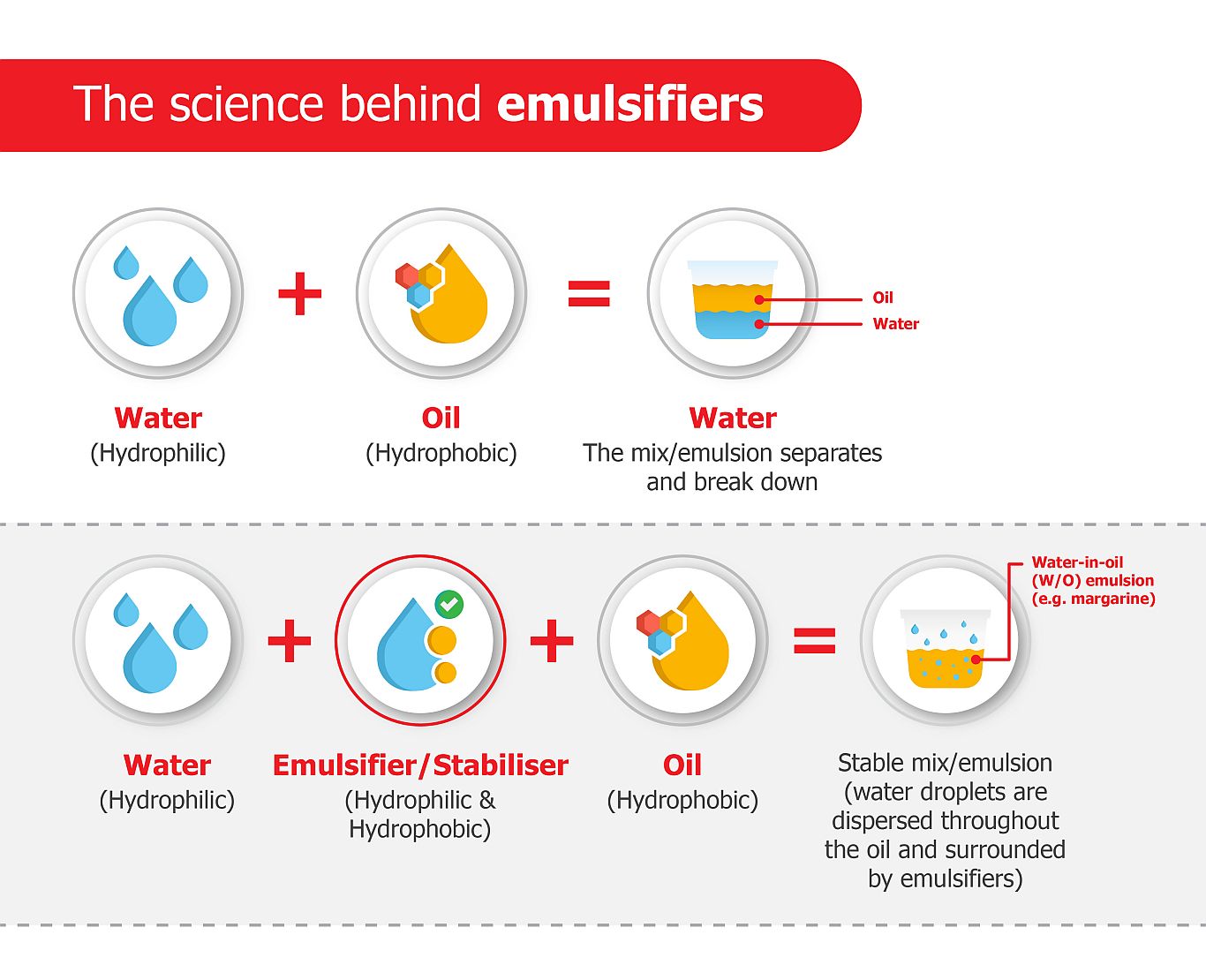
Typically, there are two types of emulsions: oil-in-water (O/W), where oil droplets are dispersed in water, and water-in-oil (W/O), where water droplets are dispersed in oil. O/W emulsions are used mainly in food products containing low oil concentrations, such as milk, mayonnaise, and vinaigrette. Meanwhile, W/O emulsions are utilised in products with high oil concentrations, such as butter, margarine, and cold cream.
Discovering types of emulsifiers for food applications
Emulsifiers come from a variety of sources. Each has its own characteristics that meet different needs in the food industry. Natural emulsifiers, for instance, can be derived from plant sources such as soy or sunflower lecithin or animal sources like egg yolk, which naturally contains lecithin.
On the other side of the spectrum are synthetic emulsifiers manufactured through chemical processes. These include substances like polysorbates, monoglycerides, and diglycerides. The appeal of synthetic emulsifiers lies in their consistency and effectiveness at lower concentrations and their ability to withstand various processing conditions, such as high heat and extreme pH levels. This versatility makes them valuable in creating a wide range of food products, from baked goods to ice cream.
Check out some of the most commonly used emulsifiers for food production below, including their sources, applications, and functions.
| Emulsifier Name | Type | Source | Function | Best Use |
|---|---|---|---|---|
| Lecithin | Natural | Soybeans and sunflower seeds | Anti-sticking; modifies viscosity | Widely used in chocolate, baking, and convenience foods |
| Mono- and Diglycerides of Fatty Acids (E471) | Both natural and synthetic versions available | Plant (soybean, grapeseed, canola, sunflower, cottonseed, coconut, palm oil) and animal sources (lard, tallow, and butterfat) | Keeps ingredients evenly mixed for dough softness, cake volume and texture; creates a creamier feel in the mouth; Reduces staling and strengthens dough | Cake, bread, peanut butter, ice cream |
| Sorbitan Esters (Span) | Originally derived from natural fatty acids, but the esterification process is synthetic | Fruits, seaweed, and algae | Prevents blooming; creates and stabilises foams; can be used as carriers for synthetic flavours | Whipped topping, cake, icing, filling, coffee whitener, non-dairy creamer |
| Polysorbates | Synthetic | Ethoxylated sorbitan (a derivative of sorbitol) esterified with fatty acids (from sources like palm oil) | Creates and stabilises foams; makes frozen desserts smoother and creamier; improves aeration in baked products | Salad dressings, ice cream, chocolates, baked goods, confectionery |
| Polyglycerol Esters (PGE) | Synthetic | Glycerol and fatty acids of vegetable oils (corn oil, cottonseed oil, palm oil) or animal oils (lard, beeswax) through direct esterification | Improves stability and plasticity of product; helps maintain homogenous texture throughout shelf life; increases foam and cake volume | Margarine, ice cream, salad dressings, cakes, cookies |
| Sucrose Esters | Synthetic | Sucrose esterified with methyl fatty acids (from sources like palm or coconut oils) | Increases mixing tolerance of dough/batter; increases product volume; and improves crumb softness | Bread, frozen dough, noodles, chocolates, confectioneries |
| Propylene Glycol Esters | Synthetic | Propylene glycol mono- and diesters of fatty acids (from edible oils and fats like palm or coconut oils) | Aids dispersion in non-dairy creamers; stabilises crystals; and increases aerations in batters and icings | Non-dairy creamers, cakes, whipped creams, icings, and toppings |
| Emulsifier Name | Type | Source | Function | Best Use |
|---|---|---|---|---|
| Lecithin | Natural | Soybeans and sunflower seeds | Anti-sticking; modifies viscosity | Widely used in chocolate, baking, and convenience foods |
| Mono- and Diglycerides of Fatty Acids (E471) | Both natural and synthetic versions available | Plant (soybean, grapeseed, canola, sunflower, cottonseed, coconut, palm oil) and animal sources (lard, tallow, and butterfat) | Keeps ingredients evenly mixed for dough softness, cake volume and texture; creates a creamier feel in the mouth; Reduces staling and strengthens dough | Cake, bread, peanut butter, ice cream |
| Sorbitan Esters (Span) | Originally derived from natural fatty acids, but the esterification process is synthetic | Fruits, seaweed, and algae | Prevents blooming; creates and stabilises foams; can be used as carriers for synthetic flavours | Whipped topping, cake, icing, filling, coffee whitener, non-dairy creamer |
| Polysorbates | Synthetic | Ethoxylated sorbitan (a derivative of sorbitol) esterified with fatty acids (from sources like palm oil) | Creates and stabilises foams; makes frozen desserts smoother and creamier; improves aeration in baked products | Salad dressings, ice cream, chocolates, baked goods, confectionery |
| Polyglycerol Esters (PGE) | Synthetic | Glycerol and fatty acids of vegetable oils (corn oil, cottonseed oil, palm oil) or animal oils (lard, beeswax) through direct esterification | Improves stability and plasticity of product; helps maintain homogenous texture throughout shelf life; increases foam and cake volume | Margarine, ice cream, salad dressings, cakes, cookies |
| Sucrose Esters | Synthetic | Sucrose esterified with methyl fatty acids (from sources like palm or coconut oils) | Increases mixing tolerance of dough/batter; increases product volume; and improves crumb softness | Bread, frozen dough, noodles, chocolates, confectioneries |
| Propylene Glycol Esters | Synthetic | Propylene glycol mono- and diesters of fatty acids (from edible oils and fats like palm or coconut oils) | Aids dispersion in non-dairy creamers; stabilises crystals; and increases aerations in batters and icings | Non-dairy creamers, cakes, whipped creams, icings, and toppings |
Types of common emulsifiers for food applications1
Are emulsifiers safe to consume?
Emulsifiers are widely used in food production and are considered safe to consume within the parameters set by food safety authorities. Regulatory bodies like the Food and Drug Administration (FDA) in the United States and the European Food Safety Authority (EFSA) in the European Union evaluate and approve the use of emulsifiers, setting guidelines for acceptable daily intakes. Before being authorised for use in food products, food emulsifiers are subjected to safety evaluations, following the same procedures applied to other food additives.
Occasional consumption of foods with emulsifiers is unlikely to pose significant health risks, and most people do not need to actively avoid emulsifiers. However, like with most foods, it is recommended to consume them in moderation.
Palm-based emulsifiers: A key ingredient to enhanced flavour and freshness
Palm oil is among the most consumed vegetable oils globally, primarily because it is used not only as a cooking oil but also in a wide range of consumer foods, including as emulsifiers for biscuits, cakes, and many food products we consume daily.
Palm-based emulsifiers offer several pros over others, making them a preferred choice in various industries, including food. Some benefits include:
- Natural Source: Palm-based emulsifiers are derived from palm oil, a naturally occurring vegetable oil. This can be appealing to consumers seeking products with natural or plant-based ingredients.
- Cost-Effectiveness: Because palm oil is the highest-yielding vegetable oil in the world, palm-based emulsifiers are often cost-effective compared to other emulsifiers. This makes them a practical choice for manufacturers looking to manage production costs.
- Versatility: Palm-based emulsifiers are often compatible with a wide range of ingredients and formulations, making them suitable for various product types.
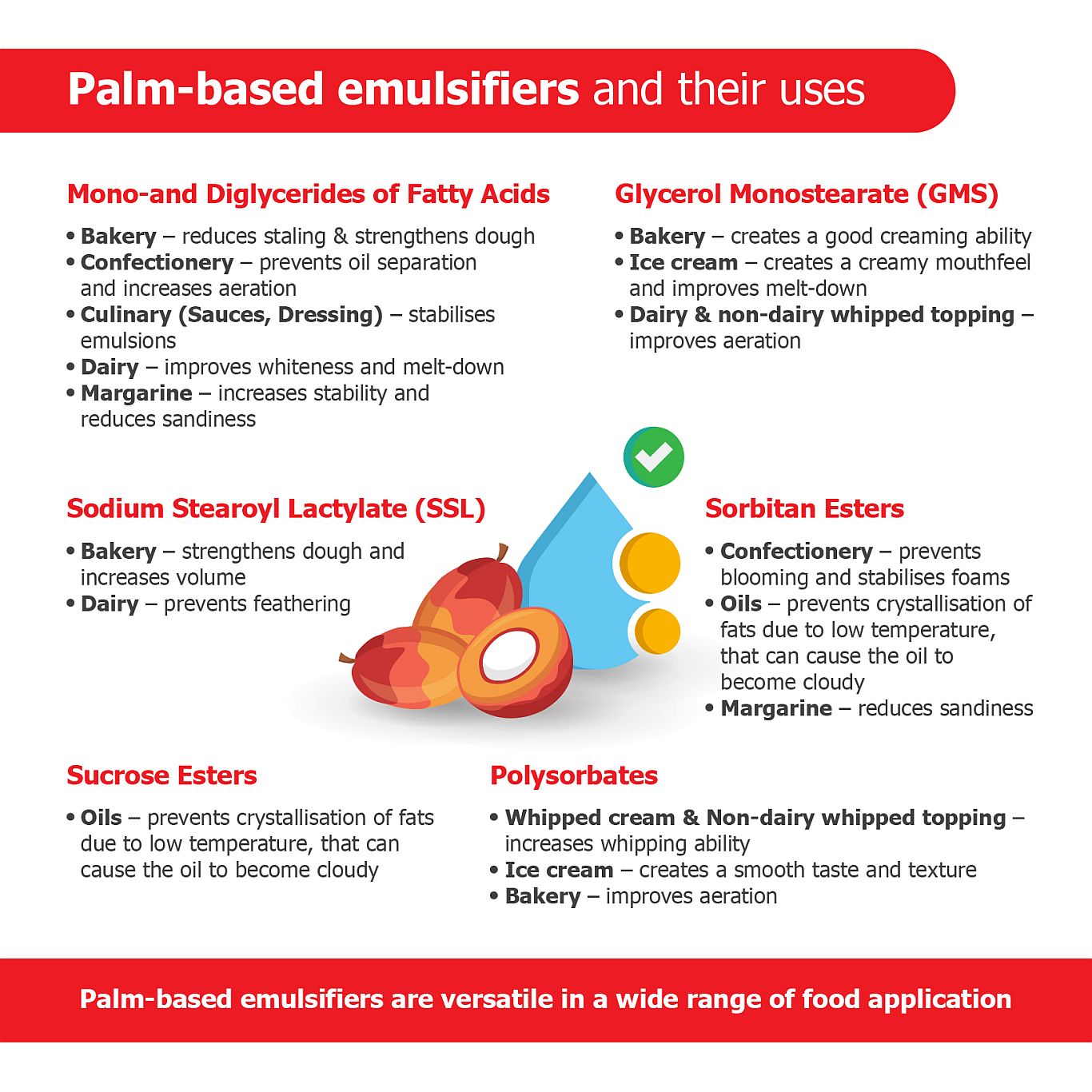
Palm-based emulsifiers contain substances such as mono- and diglycerides of fatty acids, glycerol monostearate (GMS), and sorbitan esters, which can stabilise blends of ingredients, maintain texture, and extend shelf life in products ranging from baked goods to creamy spreads and ice cream.
Read through these infographics to learn more about the most common palm-based emulsifiers, including their uses.
Navigating emulsifiers in food labels/packaging
Navigating emulsifiers on food labels or packaging involves a bit of label reading and sometimes research, as they can be listed by different names or numbers. These are a few ways to help you decode the presence of emulsifiers in your food from their labels:
1. Check the ingredients list
Emulsifiers are listed in the ingredients section of the food label. They can be named by their common name (like soy lecithin, mono- and diglycerides, or glycerol monostearate) or by their food additive E-number (like E322 for lecithin or E471 for mono- and diglycerides).
2. Understand common names
Familiarise yourself with the common names of emulsifiers. This includes lecithin, mono- and diglycerides, polysorbates, sorbitan monostearate, and others like stearoyl lactylates.
3. Know the E-numbers
Emulsifiers can also be listed by their E-number, a system used in the European Union to identify food additives. This system is aligned with the International Numbering System (INS) for food additives, established by the Codex Alimentarius, an international food standards body. While the E-number system is specific to the EU, the corresponding INS numbers are recognised globally.
4. Look for allergen information
If you’re avoiding emulsifiers due to allergies (for example, soy lecithin if you have a soy allergy), check the allergen information that often accompanies the ingredients list. This section is mandatory in many countries and can quickly alert you to the presence of common allergens.
5. Be aware of variations
Some emulsifiers like mono- and diglycerides can be made from various sources, including animal fats, so if you are vegetarian or vegan, look for labels that specify the source or choose certified vegan products.
———–
Learn more about what kinds of supermarket products contain palm oil here.
———–
1 Extracted from:
https://www.sciencedirect.com/science/article/abs/pii/B9781630670443500054
https://www.foodingredientfacts.org/facts-on-food-ingredients/sources-of-food-ingredients/mono-diglycerides/
https://www.ulprospector.com/knowledge/511/mono-diglycerides-2/
https://www.sisterna.com/food/sucrose-esters-for-food/
https://www.linkedin.com/pulse/sucrose-esters-food-emulsifier-sanmin-globe/
https://foodadditives.net/emulsifiers/sucrose-esters-of-fatty-acids/%23Components
https://www.researchgate.net/publication/287317357_Structure_and_function_of_emulsifiers_and_their_role_in_microstructure_formation_in_complex_foods